Civic Affairs
Varsity Community Association’s Letter to Mayor Jeromy Farkas and Members of City Council
March 23, 2026 Public Hearing – Repeal of Citywide Residential Rezoning
March 15, 2026
Mayor Jeromy Farkas & Members of City Council City of Calgary
Calgary, Alberta
Re: March 23, 2026 Public Hearing – Repeal of Citywide Residential Rezoning
Dear Mayor Farkas and Members of Council,
The Varsity Community Association supports the repeal of blanket rezoning and the reinstatement of the wording of the land use bylaw prior to August 6, 2024 without amendment. In addition to restoring the different low density residential land use districts it is critical that contextual rules be restored.
While changes to the rules for rowhouses are necessary, they are a separate issue and should be the subject of a subsequent public hearing after proper public engagement.
We also believe a clear and early implementation date is crucial. Only approved development permits prior to first reading should be grandfathered.
We believe blanket rezoning as well as other changes that were adopted at the same time were not in the best interests of Varsity and other communities in Calgary. Awareness of the issue is very high in Varsity and there have been several well attended public meetings on the topic of blanket rezoning and planning in general during the local area plan process. The repeal of blanket rezoning and restoration of contextual rules are strongly supported in our community. There is support for targeted density where it makes sense and where roads and other infrastructure can support that density.
Strategic and thoughtful local planning and building public trust is contingent upon the City improving its engagement policies and practices, particularly for local area plans.
The Importance of the Public Hearing Process
The only difference between blanket rezoning with one base district for all properties and the use of several different land use districts (RC-1, RC-2, etc.) is the redesignation public hearing before Council.
The right of affected persons to be heard by their elected representatives is a fundamental and essential part of the democratic process. City Administration is not directly accountable to the public for their review and decisions. Without a public hearing, there is no incentive for a developer to work with neighbours to improve the project. With blanket rezoning there has been less meaningful engagement and greater dissatisfaction with the redevelopment process. Restoring the public hearing process is essential to ensuring the voices of affected residents are acknowledged and carefully considered.
Why Is it Important to Repeal Blanket Rezoning?
The problems with rowhouses are well understood. Essentially, the building envelope of rowhouses and townhouses is massive in comparison to a single family or semi- detached home, particularly low profile bungalows.
City administration refers to rowhouses as low density housing however, public perception is quite different as most people would see increasing density from 1 or 2 units to 8-12 units as significant. Most people agree that increasing lot coverage to 60% as a very dramatic change to the pattern of development in their neighbourhood. For example, in Varsity lot coverage averages from 25 to 30%. The built form of rowhouses can dramatically change the character of the streetscape and community. It is not an unobtrusive and harmless type of development. The built form is substantially different than RC-1 or RC-2.
Blanket rezoning does not respect the unique character of individual communities or recognize the differences between laned vs laneless parcels, cul-de-sacs, irregularly shaped lots, lots with access issues, etc. Not every lot or street is suitable for a rowhouse.
Blanket zoning assumed that R-CG and H-GO projects will always comply with Section 2.2.5 of the Municipal Development Plan which states “The City promotes infilling that is sensitive, compatible and complementary to the existing physical patterns and character of neighbourhood.” Yet there are many areas where this type of infill is not compatible.
The Infill Guidelines reflect basic sound planning policies. The document states that “New development should be designed in a manner which is responsive to the local context” and that “New development should respect the existing scale and massing of its immediate surroundings.” Also, for placement of windows, “The privacy of adjacent residences should be respected”.
The negative impact of rowhouse development on adjacent properties and neighbourhoods can be significant due to 60% lot coverage, 3 storey height, loss of mature trees, reduced soft landscaping, overshadowing, overlooking, off-site parking congestion, excessive garbage and recycling needs, and an increase in intensity of use resulting in an increase in activity levels and noise. For corner lot rowhouses, 4 elevated back decks and 4-8 air conditioners face their home and back yard without much of a buffer. Very few people want to live next door to a rowhouse that overwhelms their house and yard.
Rowhouses reduce quality of life and property values for nearby properties so it’s not surprising that people panic when a For Sale goes up nearby. See Attachment A for testimony from a person who has experienced this.
That is the value in having a public hearing process – to evaluate the specifics of various land use applications and determine where this type of use works well and where it doesn’t. It is crucial that citizens have a stronger voice in the planning and development process and its impact on their communities.
The Impact on Varsity
Varsity is a very diverse and vibrant community (pop. 13,000+) with many different types of housing accommodating all income levels. Our schools are at capacity. We have 2 LRT stations and several commercial areas within our community including the University Innovation Quarter which is 76 acres targeted for high density development. We also have a significant amount of residential density including 10 apartment buildings (6-12 storeys) and numerous 4 storey condo developments with more pending. 45% of our dwelling units are single family homes and these are a highly desired housing form in our community. Varsity has a wide variety of housing options including several seniors’ homes, affordable housing, and attainable housing. It’s important to have all of these options but it is also important to preserve our RC-1 and RC-2 areas.
Varsity has been adversely impacted by numerous rowhouse applications that are not sensitive to the local context. The vast majority of homes in Varsity are very well maintained and are definitely not “tear-down” housing stock. Every application has caused huge anxiety for our residents who have legitimate concerns. People cherish their back yards, gardens, and privacy and see this as being threatened. People need certainty that new development will be respectful of their community.
Contextual Setback and Building Depth Rules
Contextual front setback and contextual building depth rules were eliminated when blanket rezoning was passed. At no time was the public informed that this was part of the new bylaw! This has had serious repercussions in established communities.
Currently, only a 3.0 metre setback is required from the front property line to a new building. The rear setback is now 7.5 metres. Front setbacks in Varsity range from 7- 12.0 metres so it’s clear that a 3 metre setback on an adjacent home would create a very undesirable result, particularly on a cul-de-sac where homes are angled towards each other. We are aware of at least two SDAB decisions to deny permits based on excessive relaxation of the front setback were overturned because of this change in a decades-old policy that has worked
The contextual rules prevented a new or renovated home from jutting far in front or behind the adjacent homes. This maintained the character of the streetscape, preserved mature trees and peripheral views, and prevented overshadowing and overlooking.
It is critical that these important contextual rules be reinstated to protect the unique character of each community. Going forward contextual setbacks should be calculated by not including setbacks that were established under the current bylaw without using the contextual rules.
Parks
Although this does not affect Varsity directly, the bylaw rezoned parks in older communities that were zoned RC-1 to R-CG instead of S-SPR. The repeal will restore the RC-1 zoning. A subsequent amendment should rezone these parks to S-SPR to protect them from development.
Secondary and Backyard/Laneway Suites on the Same Property
When blanket rezoning was approved, the bylaw was also changed to allow both secondary and backyard suites on the same property for a total of 3 dwelling units on every property. Previously only 2 dwelling units were allowed. There is no parking required for backyard suites.
The public was not aware of this change as it was not part of any public engagement. The previous rule limiting each lot to 2 units will be restored with a repeal of blanket rezoning. If Council wishes to re-evaluate this policy, they need to ensure there is extensive public engagement and establish rules that will ensure sensitivity to neighbouring properties. For example, should the height be scaled back? Should backyard suites be permitted on laneless parcels? This should be the subject of its own public hearing.
Proposed Amendments to Rules for Rowhouses
While review and revision of the rules for rowhouses and townhouses are badly needed, we do not agree with considering the proposed amendments as part of this public hearing. This should be done at a separate public hearing after consultation with Calgarians and stakeholder groups. Most citizens are unaware of these proposed amendments and they need the opportunity to review them and speak to them individually. An open and transparent process is necessary to build public confidence.
Parking
Parking requirements need a thorough review. The changes made at the blanket rezoning hearing were made without any research or consultation. It doesn’t make sense to arbitrarily establish different rules for different wards. Parking requirements should be established by looking at each community individually. Given that most households have 2 vehicles even if they live close to a major transit hub, it might be wise to return to 1.0 stall per unit for on-site parking city-wide. This needs to be debated and voted on at its own public hearing.
Affordable Housing
The 2021 Affordable Housing Deficit spreadsheet indicates there is no housing deficit for those with medium or high incomes. The housing market has risen over the years putting pressure on all income groups, however, people in the Low or Very Low Income categories have the greatest need for affordable housing and only more non-market housing will meet that need. Blanket upzoning and increased density does not create the type of affordable housing that is needed by these individuals. In fact, infill development often displaces low income residents. Subsidized housing is critically important to assist the vulnerable.
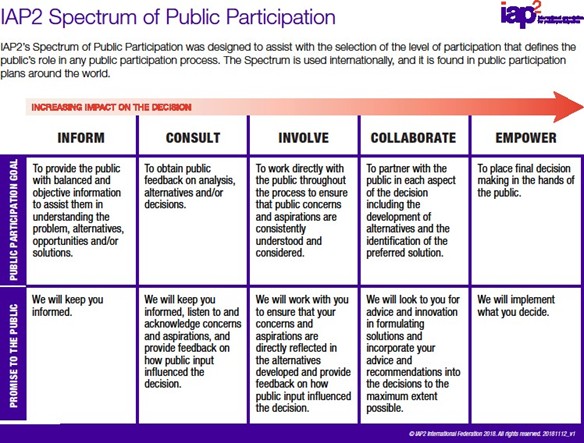
Engagement Process Overhaul Needed
The past several years has seen a top-down focus from Council and Administration which has routinely ignored critical insights from citizens across the city. The KMPG report which was commissioned by the previous Council should be publicly released in full.
Some members of City Administration need to be reminded of their role as a neutral party between citizens and developers. Best planning practices include extensive and thoughtful consultation with the public with a genuine desire to listen and engage. . A complete overhaul of the City’s engagement process is required.
Attachment B – IAP2 Spectrum of Public Participation
Local Area Plans
The engagement process for local area plans was flawed and had a pre-determined result. The City needs to reassess its processes and re-open all LAPs for further discussion and amendments. All current LAPs should be put on hold until the engagement process is reviewed and improved.
Grandfathering Applications vs Approvals
The City is proposing to grandfather applications for development permits and have an implementation date of August 2026. We believe this is an unnecessarily long period of time that will allow a flood of applications for rowhouses and cause increased anxiety to our residents. Communities are already stressed reviewing and holding public meetings on existing applications. It was clear at the time of the election and then on December 15 that blanket rezoning would likely be reversed so no one should be surprised if that is the outcome after the hearing.
Pending DP applications create no obligations for approval. Cities can change zoning without liability and there should be no expectation that zoning will remain the same. Only approved development permits are valid as legal, non-conforming uses.
We believe only approved development permits should be grandfathered. First reading of the bylaw should be the definitive transition gate. This is supported by case law.
Request to Reword Exemptions to Restoring Previous Land Use Districts
Calgary homeowners received a letter in the mail from the City entitled “Notice of Public Hearing on Planning Matters”. Under the heading “What is being proposed?” the wording of the second bullet point should be reworded as follows when the motion is put before Council:
“Change the zoning of residential properties back to what existed before the citywide Rezoning for Housing in 2024, except for properties that:
- Delete: Received approval for a development permit, building permit or subdivision application under R-CG, R-G, or H-GO zoning before the proposed bylaw takes effect; or
- Replace with: Received approval for a development permit for a rowhouse, townhouse, or cottage cluster under R-CG or R-G before first reading of the bylaw; or
- Delete: Submitted a development permit, building permit or subdivision application before the first reading of the proposed bylaw; or
- Replace with: Received an approval for a development permit before the first reading of the proposed bylaw; or
- Rezoned through an approved rezoning application applied for by the property owner after August 6, ”
Rationale:
It is crucial to clarify these rules for exemptions to restoring the previous zoning. Building permits (BP) and subdivisions should not change the restoration of the previous zoning. If a property was subdivided for the purpose of two single family dwellings, it should not retain R-CG zoning but should be rezoned back to RC-1. Even if the intent was to build rowhouses on the subdivided lots, it should revert back to RC-1 as a subdivision is not the same thing as a development permit application or approval.
An application for a building permit for a garage or deck should not prevent that property from being rezoned back to RC-1 or RC-2. A DP approval for a new single family dwelling or an addition to a home should not be justification to keep a zoning of R-CG. If a property has a DP approval for a semi- detached or duplex dwelling, the zoning should be changed from R-CG to RC-2 to conform with what is intended under the DP.
If a property has been rezoned from R-CG (or from RC-1 or another zoning) to H-GO, that zoning stands on its own accord and will not be changed with the repeal as it was rezoned at its own public hearing. This is covered under the third bullet point so there is no need to mention H-GO in the first bullet point. Technically the last bullet point isn’t required as there would have been no rezonings to R-CG after August 6, 2024.
As noted above, with respect to the proposed exceptions to restoring the previous zoning, we request the following wording be changed to:
“Change the zoning of residential properties back to what existed before the citywide Rezoning for Housing in 2024, except for properties that:
- Received approval for a development permit for a rowhouse, townhouse, or cottage cluster under R-CG or R-G before first reading of the bylaw; or
- Received an approval for a development permit before the first reading of the proposed bylaw; or
- Rezoned through an approved rezoning application applied for by the property owner after August 6, ”
The Proposed Zoning Bylaw
Repealing blanket rezoning and reopening LAPs are two important policy issues but the biggest issue is the new Zoning Bylaw which proposes a major change in planning policies including collapsing all residential districts into three categories, H-1 (R-CG), H- 2 (H-GO), and H3 (everything else). It essentially restores a base zoning of R-CG for all properties. There is no demonstrated need to replace the Land Use Bylaw as amendments can be made to update the existing bylaw as required.
Engagement has been poor so far on the proposed Zoning Bylaw. Calgary’s engagement policies need to be addressed and improved before any action is taken to replace the Land Use Bylaw or the Municipal Development Plan.
There are many embedded policies that are very controversial such as eliminating residential parking requirements, changing many discretionary uses to permitted, changing parks categories, etc. The public needs to be made aware of these and involved in a truly collaborative effort to look at both of these proposed plans. For now, work on the Zoning Bylaw and Calgary Plan (to replace the current MDP and Transportation Plan) should be put on hold.
Conclusion
- The Varsity Community Association supports the repeal of blanket rezoning and the reinstatement of the wording of the land use bylaw prior to August 6, 2024 without
- We recommend that changes to the rowhouse rules be the subject of a subsequent public hearing following collaborative public
- We recommend that all properties revert to their original zoning except for those with development permits for rowhouses, townhouses, or cottage clusters that are approved prior to first reading of the
- We recommend that the City’s engagement process be reviewed and amended after extensive engagement with the
Thank you for your consideration of this submission.
Yours truly,
Jo Anne Atkins
Director of Civic Affairs
Varsity Community Association
ATTACHMENT A
Statement of a Homeowner Impacted by R-CG:
“I’ve been living in my home since 2006. I purchased my home because I loved the community, the trees, the neighbours and lovely sunlight and privacy I had in my backyard and on my deck to enjoy the south facing view of the trees. This new enormous development has blocked the sunlight in my backyard and now it’s cold and full of shade by 4 pm. I have no privacy in my backyard anymore as there are several windows that overlook right into my yard from above. I don’t feel comfortable being out on my back deck as people can stare at me. I have no view of the skyline or trees anymore as the development takes up the entire lot next to me. It’s a horrible sight and feels very cold and sterile and is way
over-built for the lot and doesn’t fit with the neighbourhood. I’m not sure what impact it will have on my property value but I’m sure I will have a hard time selling now. I no longer want to live here and will be listing my house. I just don’t feel comfortable here anymore and can no longer enjoy my home the way I want to. It’s incredibly disappointing and I’m very unhappy with Council’s decision. I would have welcomed a semi-detached home. This development is ridiculous and didn’t need to happen.”
ATTACHMENT B